

From the Ocean,
for Life.
海から、命の水を。
In disasters, at sea, on remote islands, in deserts. SHO-Aqua System turns seawater into drinking water on-site—an autonomous infrastructure that builds a future where people can live beyond the limits of water.
- Daily Output
- 20–30t / day
- Operation
- 24hours
- Emergency Supply
- 10,000people / day
- Footprint
- 20ft container × 2
We transform the ocean into an infinite source of safe water.
From centralized systems to distributed networks.
From dependence to resilience.
In an era of environmental volatility, water remains both the foundation of life and its most fragile resource.
Our mission is to enhance community and industrial resilience through autonomous seawater desalination systems that create potable water on-site—wherever it’s needed.
This is more than engineering. It is a redefinition of infrastructure—a movement to ensure “the right to water” for all people.
On a water planet, only 0.01% is usable by humanity.
About 97.5% of Earth’s water is seawater and about 2% is locked in glaciers and icebergs. Conventional desalination faces serious limitations.
Reverse Osmosis (RO)
Salt, microorganisms and pollutants such as microplastics clog the membranes, requiring frequent chemical cleaning and replacement. High pressure also means high energy consumption.
Multi-Stage Flash (MSF)
Heating seawater consumes vast amounts of thermal energy. Suited only to large plants with very high capital costs—uneconomical for small facilities.
Advanced Pre-treatment + RO Membrane.
S = Safe, H = High-quality, O = Ocean — technology for delivering safe, high-quality water from seawater. Three key points define our proprietary development.
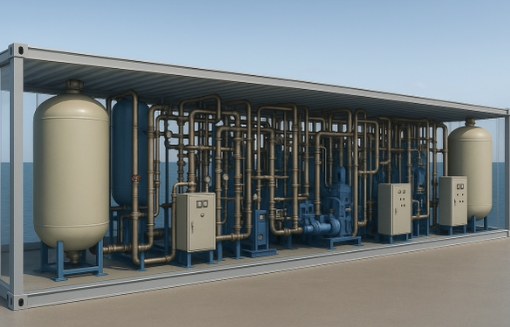
Less burden on RO membranes
Seawater contains far more plankton than imagined; passing it directly through RO membranes causes clogging and replacement every 3–6 months. Our advanced pre-treatment extends membrane life to one year (1st stage) and three years (2nd stage).
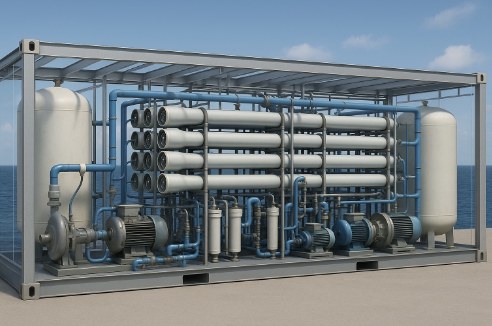
Lower operating costs
With plankton and particles removed, lower water pressure is needed to pass seawater through the membrane. Automated maintenance simplifies operation—an innovative filtration system.
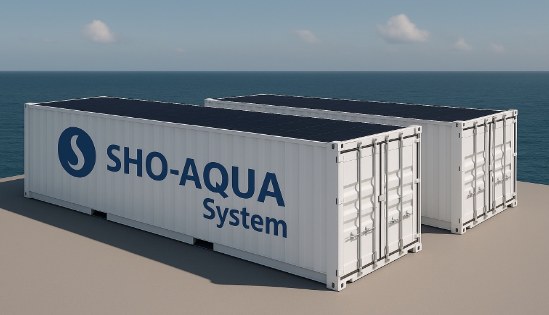
Mobile processing plant
All equipment is integrated into containers for straightforward installation in disaster areas. Optional solar power and self-contained generators enable emergency operation.
System Flow
- Raw seawaterRaw water storage tank
- Pre-treatment unitProprietary advanced pre-treatment
- Primary purification tank
- Pre-treatment filter
- Secondary purification & filtration
- RO (reverse osmosis) unit
- RO membrane
- Water storage tank
- Supply pump → supply line
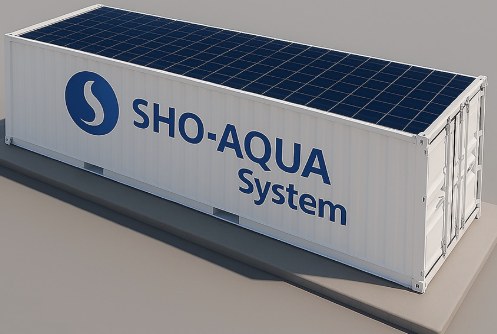
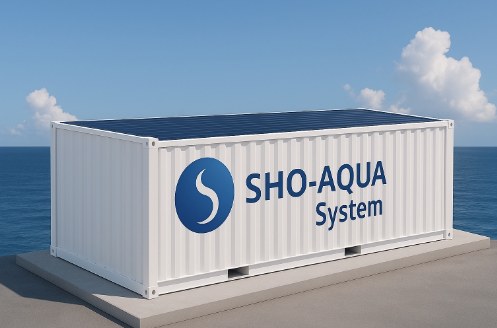
Next-generation mobile seawater drinking system.
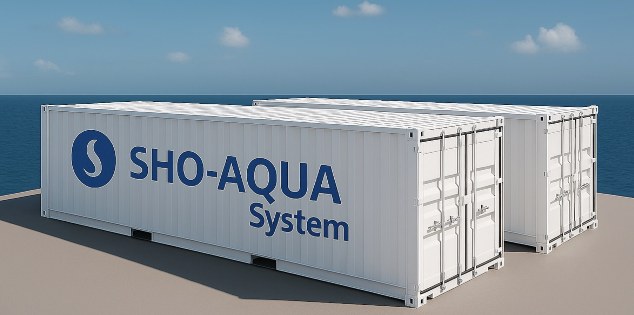
| Configuration | 1 unit = 2 containers |
|---|---|
| Container size | 20ft — L 6.06m × W 2.44m × H 2.59m |
| Power | Electricity (200V) |
| Operation | 24 hours |
| Output | 20–30 t of drinking water / day |
| Normal use | 133–200 people / day (approx. 150L per person) |
| Emergency | 6,666–10,000 people / day (approx. 3L per person) |
Options
| CIGS thin-film solar panels | Conversion efficiency 17–18% (flat) · 70% output on walls · installable on three sides (excluding north) · 160W/m² · −40℃ to 90℃ · salt-resistant · covers approx. 1/12 of required power (10kWh) |
|---|---|
| Diesel generator | Rated output 8–10kW · light oil · 24h continuous operation · 80–100L tank · soundproof · approx. 2.5L/h |
| Compact unit | Small, mobile drinking water unit powered by a small power source or manually—for personal voyages, lifeboats and offshore workers. |
Specifications are subject to consultation.

Creating water sources where pipelines cannot reach.
Remote islands
Daily water supply
Disaster relief
From stockpiles to mobile water sources
Ports & vessels
Drinking water at sea and in harbors
Deserts & farms
Irrigation water
Resorts
Autonomous water source for hotels
A fundamental solution to the dioxin problem.
Our proprietary technology uses foaming water glass, “ND Clean”. Simply retrofitted to existing incinerators and sprayed into the flue, it suppresses dioxin formation at the source and encapsulates hazardous substances within a glass structure.
Verified by third-party analysis (ISO/IEC 17025)
or less vs. building a new high-temperature melting furnace
Operational within weeks to a few months
Cd, Pb, Cr6+, As, Hg not detected after treatment
- STEP 01
Spray
Special agent sprayed into the incinerator flue.
- STEP 02
Capture
Dioxins and heavy metals captured in a glass structure.
- STEP 03
Detoxify
Re-synthesis of organochlorine compounds suppressed.
- STEP 04
Recycle
Treated material reused as safe building material.
Case study: Keiyo Clean Center (Sakura City, Chiba). Source: Chiba Pharmaceutical Association Inspection Center / Sumika Chemical Analysis Service — official analysis results.
Environmental technology since 1993.
| Company | P&S Corporation (株式会社ピーアンドエス) |
|---|---|
| Headquarters | 6-37-4-1302 Higashimukojima, Sumida-ku, Tokyo, Japan |
| Founded | 1993 |
| Incorporated | May 2005 |
| Capital | JPY 10 million |
| Business | R&D and sales of chemicals and agrochemicals; architectural design and construction; environmental consulting |
| Patents | 3 industrial property rights (patents) acquired |
- 1993Founded as an environmental consultancy
Developed a hydrogen generator; developed ND-100 heavy-metal insolubilizing agent.
- 2005P&S Corporation incorporated
- 2009Launched Sanclo II
Stabilized chlorine dioxide deodorizer and disinfectant
- 2018Radioactive soil washing system
- 2021Radioactive water purification system
- 2025Launched SHO-Aqua System
Let’s talk about your water.
We welcome inquiries for technical documents, cost estimates and site surveys. Tell us your application, required volume and operating conditions, and we will propose the optimal configuration and implementation plan.